
That moment you sit down at a desk covered in papers, coffee cups, and tangled cords, and feel your focus instantly vanish. It is a universal experience. But what if that mess is doing more than just annoying you? What if it is actively working against your brain’s ability to function?
A cluttered environment has a direct, measurable impact on your mind. The good news is that by learning to keep your workspace clutter-free, you can reclaim your focus, lower your stress, and unlock a more productive and peaceful workday.
The Science Behind The Mess: How Clutter Hijacks Your Brain

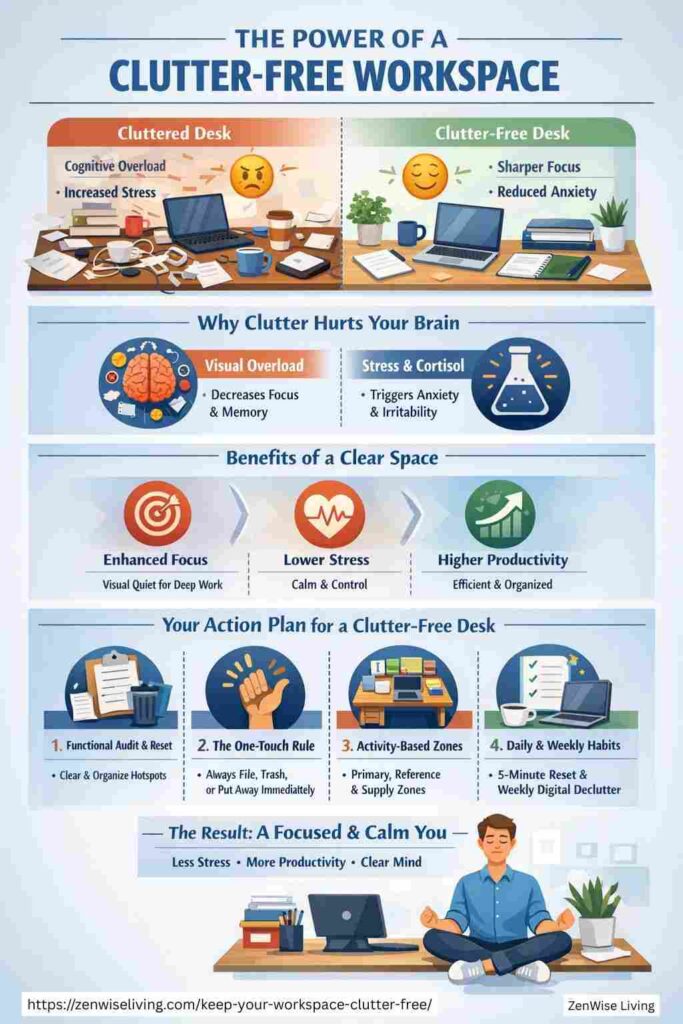
A cluttered space is more than an eyesore. It is a source of constant “visual noise.” Your brain has a limited capacity for attention, and every item in your sightline competes for a piece of that valuable cognitive resource. This bombardment creates cognitive overload, a state where your working memory is overwhelmed.
Research highlighted by Psychology Today confirms that this visual distraction significantly reduces your brain’s ability to process information and maintain focus. It is like having too many apps running on your phone at once, and everything slows down while your mental battery drains faster.
The impact goes beyond focus. Clutter is a potent, chronic stressor. A pivotal study published in the Journal of Environmental Psychology established a strong link between clutter and decreased well-being. Physiologically, clutter can elevate cortisol, your body’s primary stress hormone.
This puts you in a low-grade “fight or flight” mode, which increases feelings ofanxiety and irritability. Furthermore, each unfinished project or unsorted pile exploits a psychological principle called the Zeigarnik Effect, which causes your brain to cling to incomplete tasks.
This creates underlying mental tension, and it makes true relaxation and deep concentration difficult even when you try to focus on a single task.
The Transformative Benefits Of A Clear Space
Clearing your desk does the opposite of everything described above. It creates “visual quiet,” and this allows your brain to stop filtering chaos and start engaging deeply with your work.
This calm environment transforms your desk from a stress trigger into what Ibercenter terms a “performance enabler.” You will spend less mental energy managing your environment and more on actual problem-solving and creative thinking.
Having an organized, dedicated “home base” also fosters psychological ownership. As summarized by WORKTECH Academy, this sense of control and personal territory is linked to higher job satisfaction, commitment, and overall well-being.
It tells your brain, “This is my place for focused work,” and it makes it easier to get into a state of flow. The benefits compound because with less time wasted searching for lost items, reduced mental fatigue, and a greater sense of command over your tasks, your efficiency and calm naturally increase.
Your Actionable Plan For A Clutter-Free Workspace
Transforming your space does not require a massive, overwhelming overhaul. It is about building smart, sustainable habits. Here is your practical, four-step plan:
1. Start With A Strategic “Functional Audit” And Reset
Do not just tidy up. Instead, analyze first. Spend a day noticing where clutter naturally accumulates, like mail, cables, or cups. This reveals your personal “clutter hotspots.”
Then, dedicate one hour to a full reset where you clear the surface, trash what is unnecessary, and give everything a designated “home” in a drawer, tray, or shelf.
2. Implement The “One-Touch” Rule
This is the golden rule for maintenance. The moment you handle an item, whether it is a piece of mail, a used dish, or a tool, you must decide its fate immediately.
You should file it, trash it, or return it to its home. Never put something down “for now,” because this single habit prevents piles from ever forming again.
3. Design Your Desk With Activity-Based Zones
Organize your space by function. Your Primary Zone, which is directly in front of you, should hold only your current task’s essentials like your laptop and notebook.
Your Reference Zone to the side holds today’s active projects. Your Supply Zone in a drawer contains pens, chargers, and other tools. This logical flow minimizes unnecessary movement and distraction.
4. Establish Two Non-Negotiable Maintenance Habits
The 5-Minute End-Of-Day Reset
Before finishing work, spend five minutes restoring your Primary Zone. File papers and put supplies away. This gift to your future self ensures a calm, ready start every morning.
The Weekly Digital Declutter
Digital chaos causes the same mental drag. Each week, spend 15 minutes deleting old files, organizing downloads, and unsubscribing from junk email. A clean digital desktop supports a clear mind.
More Than Just a Tidy Desk
Committing to a clutter-free workspace is an act of self-respect. It is a conscious choice to design an environment that supports your goals rather than sabotages them. You are building a sanctuary for your attention, defending your time, and creating the physical conditions for mental clarity.
The path is straightforward, so start with your five-minute reset tonight. Experience the profound calm of a clear space tomorrow, and let your organized desk become the foundation for a more focused, intentional, and productive you.
Common Questions About Why You Need to Keep Your Workspace Clutter-Free
A clear workspace is important because clutter acts as visual noise which competes for your brain’s attention. This reduces your focus and increases stress, as research has linked office clutter to lower well-being.
It is an intentionally organized environment where every necessary item has a designated home. It is a designed system that minimizes distraction to actively support focus and efficiency.
Keeping your workplace clean is vital because physical clutter is a chronic stressor. An orderly space directly supports mental health by reducing this ambient stress, which is linked to decreased well-being.
Clearing clutter provides key benefits: it sharpens your focus, saves time spent searching, reduces stress, and creates a greater sense of control and calm over your environment.
Clutter affects your mind by causing cognitive overload and it increases stress. The visual chaos depletes mental energy for concentration, and the unfinished tasks it represents can keep your brain in a state of background anxiety.
Read More:
How to Improve Concentration and Beat Decision Fatigue