
Have you ever had one of those days where you feel stuck in a rut? You scroll through your phone looking for a spark, or maybe reach for a sugary snack, or just cannot seem to find the energy to start that task you have been putting off.
What you are actually craving in those moments is not just a distraction, but a natural boost of a powerful brain chemical called dopamine. Think of dopamine less as a simple “happy pill” and more as your brain’s motivation molecule. It is the signal that drives you to seek, strive, and achieve. It helps you focus, find things pleasurable, and get things done.
But sometimes, our modern world hijacks this beautiful system. We get trapped in loops of easy, fleeting dopamine hits from social media likes, junk food, or binge-watching that leave us feeling more drained than energized. You may have even heard of extreme “dopamine detoxes” promising a reset.
But here is the truth from the experts. Psychologist Dr. Susan Albers of the Cleveland Clinic clarifies that we cannot and should not try to eliminate this vital chemical.
“We need dopamine in every system in our body — to move, to sleep, to experience pleasure,” she says. “So, it’s a critical component that we can’t and don’t want to get rid of.”
As Dr. Peter Grinspoon of Harvard Health Publishing notes, the popular idea of a “dopamine fast” is a misunderstanding of a method originally meant to reduce compulsive behaviors. The term was coined by psychiatrist Dr. Cameron Sepah as a catchy title for a cognitive behavioral therapy technique, and not a literal fast from the chemical itself.
Neuroscientists point out that the idea of “resetting” dopamine with a short fast does not align with the complex science of how this neurotransmitter actually works.
The real goal is not to detox from dopamine, but to nourish and recalibrate your brain’s natural reward system. It is about moving from chaotic, reactive hits to sustainable, intentional habits. By making simple choices, you can build a lifestyle that supports steady energy, clear focus, and genuine satisfaction.
This guide will walk you through the 12 best healthy habits that release dopamine naturally, helping you design a life with less mental clutter and more consistent flow.
12 Best Healthy Habits That Release Dopamine

Feed Your Brain’s Reward System
You truly are what you eat, especially when it comes to your brain chemistry. Dopamine does not just magically appear. Your body needs specific raw materials to produce it. The habits in this section are all about giving your brain the best building blocks from your diet.
1. Eat Protein-Packed Foods
The science here is wonderfully straightforward. Dopamine is built in your brain from an amino acid called tyrosine. Amino acids are the components of protein, so consuming protein-rich foods directly supplies the precursors your body needs.
You do not need a complicated diet. Just aim to include a good source of protein in each meal.
Actionable tips to start today:
- Add a handful of almonds or walnuts to your morning oatmeal or yogurt.
- Choose eggs, Greek yogurt, or a smoothie with protein powder for breakfast.
- Incorporate lean meats like chicken or turkey, fish, tofu, or lentils into your lunch and dinner.
- Snack on cottage cheese or edamame.
Starting your day with these foods can help provide the foundation for steady dopamine production throughout the morning.
2. Eat Foods Rich in Iron, B6, and Folate
Think of tyrosine as the main building block, but your body needs a skilled construction crew to turn it into dopamine. That is where key vitamins and minerals come in. Iron, vitamin B6, and folate are essential cofactors in the production line, and a shortage of these nutrients can slow the whole process down.
Focus on adding these delicious foods to your plate:
- For Iron: Spinach, kale, lentils, and fortified cereals.
- For Vitamin B6: Chickpeas (hello, hummus!), tuna, salmon, bananas, and potatoes.
- For Folate (Vitamin B9): Leafy green vegetables, asparagus, broccoli, and citrus fruits.
The key is variety. A colorful plate is often a dopamine-supportive plate.
3. Eat Probiotic Foods
This habit taps into one of the most exciting areas of health science: the gut-brain connection. Your digestive system and brain are in constant conversation through a complex network. Researchers are learning that the trillions of bacteria in your gut do not just help with digestion. They can also influence your brain chemistry and mood.
For example, the Healthline guide to happy hormones lists probiotic-rich fermented foods like kimchi, yogurt, and sauerkraut as items that can influence the release of feel-good hormones. Research into “psychobiotics” suggests that nurturing a healthy gut microbiome is a science-backed way to support your overall brain health.
You can support your gut by eating probiotic-rich fermented foods.
Simple ways to get your probiotics:
- Enjoy a serving of yogurt or kefir with live and active cultures.
- Add a spoonful of sauerkraut or kimchi as a tangy side to your meal.
- Try a refreshing bottle of kombucha, but just check the sugar content.
By making these foods a regular part of your diet, you are feeding the complex ecosystem within you that plays a supporting role in your well-being.
Use Your Body’s Natural Rhythm
Your body is designed to move, rest, and sync with the natural world. These next three habits leverage your body’s innate cycles to regulate and boost your dopamine levels in a powerful, organic way.
4. Move Your Body Every Day
You have likely heard that exercise is good for your mood, and there is solid science behind that glow. Physical activity is a proven way to increase dopamine circulation in your brain. It also boosts other feel-good chemicals like endorphins and serotonin, creating a powerful cocktail for well-being.
The best part? It does not have to feel like a punishing workout. In fact, finding joy in movement is the secret to making it a lasting habit.
Forget the gym if you hate it. Instead, think about:
- Taking a brisk walk while listening to your favorite podcast or an upbeat playlist.
- Having a five-minute dance party in your living room to one song that always gets you moving.
- Gardening, stretching while watching TV, or playing with your kids or dog.
- Trying a fun online yoga or dance tutorial.
The goal is to associate movement with pleasure, and not punishment. What is one way you could move joyfully for just 10 minutes today?
5. Prioritize Quality Sleep
If you are skimping on sleep, you are directly sabotaging your dopamine system. Dopamine release follows a strong circadian rhythm. It naturally rises in the morning to help you wake up and feel alert, and it tapers off in the evening.
Poor or inconsistent sleep blunts this rhythm. It makes your brain less sensitive to dopamine the next day, which you experience as brain fog, lack of motivation, and craving more caffeine and sugar.
You cannot supplement your way out of bad sleep. You have to prioritize it.
Start with one or two of these sleep hygiene tips:
- Be Consistent: Try to go to bed and wake up at roughly the same time every day, even on weekends. This trains your brain’s internal clock.
- Create a Buffer: Power down phones, tablets, and laptops at least 30 minutes before bed. The blue light from screens suppresses melatonin, the sleep hormone. Try reading a physical book or listening to calm music instead.
- Optimize Your Cave: Make your bedroom cool, dark, and quiet. Consider blackout curtains and a white noise machine if needed.
6. Get Morning Sunlight
This might be the simplest and most profound habit on this list. Exposure to bright morning sunlight does more than just help you produce vitamin D. It is a direct signal to your brain to regulate dopamine production and solidify your sleep-wake cycle.
How to make it a habit:
- Have your morning coffee or tea outside on your porch, balcony, or by a sunny window.
- Take a short five to ten-minute walk first thing in the morning.
- If you work from home, position your desk near a window.
The benefits are backed by science. Research shows that sunlight exposure can increase the production of serotonin, a key partner to dopamine in regulating mood. By getting morning light, you are giving your brain’s motivation center a natural, gentle wake-up call every single day.
Train Your Brain’s Focus
Dopamine is not just about what you do with your body, but how you direct your mind. The following habits help you train your brain’s reward pathways away from distraction and toward deep, satisfying focus.
7. Practice Mindfulness
In our hyper-connected world, our attention is constantly fractured. Mindfulness or meditation is the antidote. Research highlighted by Harvard Health Publishing finds that the change in consciousness during meditation may trigger the release of dopamine. More importantly, it strengthens the parts of your brain responsible for attention and emotional regulation, making you less reactive to stress and distraction.
If the word “meditation” sounds intimidating, reframe it as “mindful breathing.”
Here is the simplest way to start:
- Set a timer for just 60 seconds.
- Sit comfortably and close your eyes.
- Focus all your attention on the sensation of your breath going in and out of your nose.
- Your mind will wander. That is completely normal and the whole point. The moment you notice it, gently guide your attention back to your breath. No scolding, just guiding.
That is it. Do this once a day. The act of noticing your mind has wandered and bringing it back is like a bicep curl for your brain’s focus muscle, and dopamine is part of the reward.
8. Break Tasks into Small Wins
Your brain loves progress. One of the most reliable times it releases dopamine is when you anticipate a reward and then achieve it. You can hack this system by creating more opportunities for small victories.
A big, vague goal like “write report” feels daunting and offers no dopamine along the way. But breaking it down changes everything.
Transform your to-do list from daunting to doable:
- Instead of: “Write report.”
- Write: “1. Open document and create outline. 2. Write three bullet points for the introduction. 3. Find and insert two key data charts.”
Every time you physically check off one of those micro-tasks, you get a little surge of accomplishment, which is a little dose of dopamine. This builds momentum and makes starting the next step easier. It turns a slog into a series of rewarding steps.
9. Listen to Music You Love
This is perhaps the most enjoyable habit on this list. Putting on your favorite tunes is not just a distraction. Scientific research, including studies referenced by Healthline, confirms that listening to music you enjoy stimulates dopamine release in the brain. It is a powerful, instant tool for shifting your emotional state and boosting focus.
Make it intentional:
- Create a “Focus Flow” playlist with instrumental or lyric-light music for work.
- Have an “Energy Boost” playlist for when you need to clean the house or get motivated to exercise.
- Create a “Chill Out” playlist for evenings to help you unwind.
The music provides a positive stimulus that can help shift your mindset, making it easier to become absorbed in the task at hand and push through procrastination.
Design a Supportive Lifestyle
Finally, dopamine is deeply social and responsive to your environment. The last three habits are about designing your daily life and interactions to naturally support your brain’s reward system.
10. Connect with Others
We are wired for connection. While oxytocin is the star hormone for bonding, positive social interactions are also a fantastic source of dopamine and endorphins. A good laugh with a friend, a warm hug, or a stimulating conversation can all give you a mood boost.
This does not have to mean hours of socializing because micro-connections count.
Weave small moments of connection into your week:
- Send a funny meme or a genuine “thinking of you” text to a friend.
- Have a five-minute video call with a family member just to say hi.
- Give your partner or pet a few minutes of undivided attention.
- Share a smile and a thank you with your barista or cashier.
Laughter, in particular, is a potent trigger. Healthline notes that laughter therapy can help improve mental health by boosting dopamine and endorphin levels. So watch that funny show, call the friend who always makes you chuckle, and do not underestimate the power of a good belly laugh to reset your day.
11. Try New Things
Novelty is a powerful dopamine trigger. When you experience something new, your brain pays attention and releases dopamine as part of the learning and exploration process.
Routine is comfortable, but it can dull your sense of engagement. Introducing small bits of novelty can reawaken your curiosity and energy.
You do not need to skydive. Just change a small pattern:
- Take a different route on your daily walk.
- Cook a recipe from a cuisine you have never tried before.
- Listen to a music genre or podcast category that is outside your usual.
- Visit a new park, coffee shop, or store in your town.
These small adventures break the monotony and signal to your brain that the world is interesting, which is a fundamental source of motivation.
12. Audit and Adjust Your Habits
This is the meta-habit that brings it all together. Instead of following the trendy but misleading idea of a “dopamine detox,” adopt a more thoughtful and effective strategy. As explained by Dr. Susan Albers of the Cleveland Clinic, the original concept popularized by Dr. Cameron Sepah was really a form of cognitive behavioral therapy (CBT) for habit change. Think of it not as a detox, but as a Dopamine Audit.
The goal is not to eliminate pleasure, but to consciously reduce compulsive, low-value behaviors that drain your time and focus, making space for the richer, sustainable habits on this list.
Here is a simple CBT-inspired framework based on Dr. Albers’ advice:
- Identify: Pick one compulsive behavior you would like to reduce. Be specific. Example: “Scrolling through social media mindlessly for 30 minutes when I first wake up.”
- Experiment: For one week, replace that behavior with a healthier one from this list. Example: “I will leave my phone in another room overnight and spend the first 10 minutes of my day having coffee by the sunny window instead (Habit 6).”
- Observe: Keep brief notes. How do you feel during the new habit? Is the urge to do the old habit less powerful by the end of the week?
- Iterate: Use what you learn. Was it successful? Try another week or adjust. Then, pick another habit to audit.
This process empowers you to be the designer of your own life. You are not detoxing, but you are thoughtfully curating your daily experiences to support the focus, energy, and flow you want.
Build Your Dopamine-Smart Lifestyle
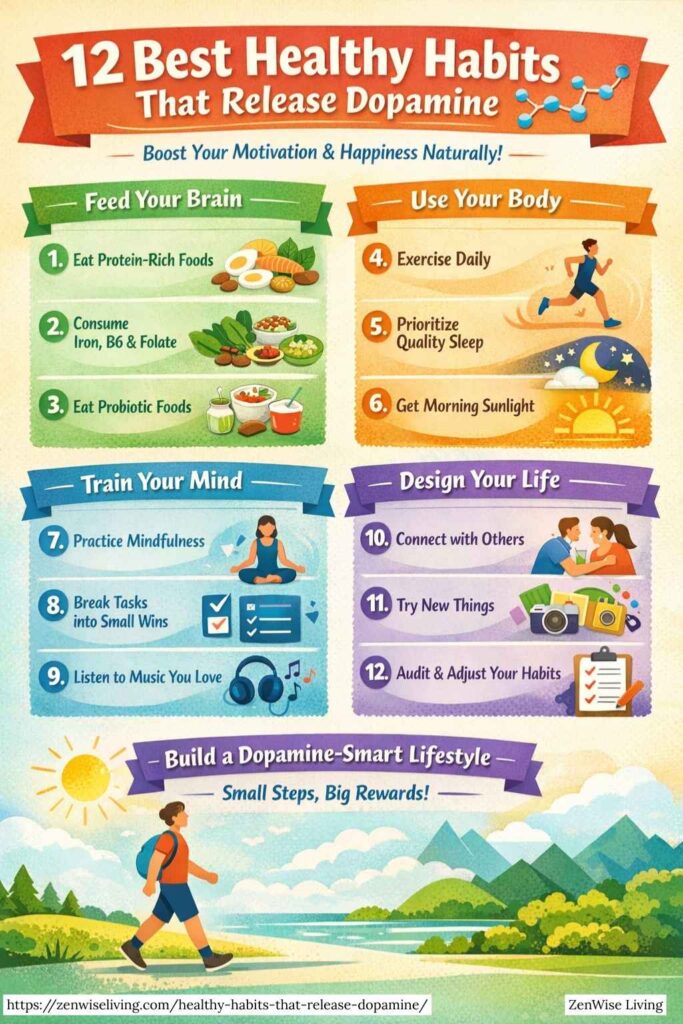
You have made it through the list. You now have a powerful toolkit of 12 healthy habits that release dopamine naturally. Remember, this is not about perfection or doing all 12 at once. That would be overwhelming and counterproductive.
The path to consistent motivation and mental clarity is paved with small, consistent actions. It is about intentional integration, and not a complete overhaul. The magic happens when you start to view these habits not as chores, but as loving ways to nourish your brain’s innate motivation system.
So, what is your first step? Look over the list or the quick guide below. Which one habit feels the most intriguing, doable, or exciting to you right now? Maybe it is as simple as adding a handful of almonds to your snack tomorrow (Habit 1), taking a 10-minute walk in the sun (Habits 4 & 6), or breathing mindfully for just 60 seconds today (Habit 7).
Pick one. Try it for a few days. Notice how it makes you feel. Then, perhaps, add another. By choosing habits that nourish your neurochemistry, you are not just chasing fleeting pleasure. You are designing a life where motivation, focus, and genuine satisfaction can flow steadily and sustainably.
Which of these twelve habits will you try first to design your day for more natural energy and flow?
Common Questions About Healthy Habits That Release Dopamine
The healthiest ways to release dopamine involve simple, sustainable habits that work with your body’s natural rhythms. Focus on actions like completing small tasks, enjoying music, moving regularly, and eating protein-rich foods. Incorporating mindfulness and seeking positive novelty also effectively support your brain’s intrinsic reward system.
You can trigger dopamine naturally by eating foods rich in building blocks like tyrosine, found in chicken, almonds, and leafy greens. Equally important, regularly engaging in activities you genuinely enjoy, like listening to music or a hobby, stimulates your brain’s own reward pathways.
While there’s no single “highest” trigger, consistently supporting your brain’s chemistry is key. Eating enough protein provides the tyrosine needed for dopamine production. Pair this with regular exercise, quality sleep, and activities you find rewarding for the most sustainable effect.
Signs of low dopamine often include a noticeable lack of motivation and persistent fatigue. You might also experience difficulty concentrating, low mood, and a loss of interest in things you usually enjoy. These symptoms reflect your brain’s reward system needing support.
Poor sleep is a major disruptor of healthy dopamine function. It blunts your brain’s natural dopamine rhythm, making you less responsive to its motivating signals. This is why consistent, quality sleep is foundational, not optional, for balanced brain chemistry.
Read More:
How to Improve Concentration and Beat Decision Fatigue
5 Healthy Habits to Live Longer That Are Surprisingly Simple