
Have you ever tried to focus on a messy desk and just felt… stuck?
You are not imagining it. There is real science behind that feeling. Which is exactly why keeping your workspace clutter-free matters so much. Researchers at Princeton University found that when there is too much stuff around you, your brain has to work harder just to ignore it. That means less energy left for actual work.
The good news is you do not need to spend a whole weekend overhauling your office. You just need a few simple moves. Here are seven easy steps to a clean and organized workspace and calm your mind.
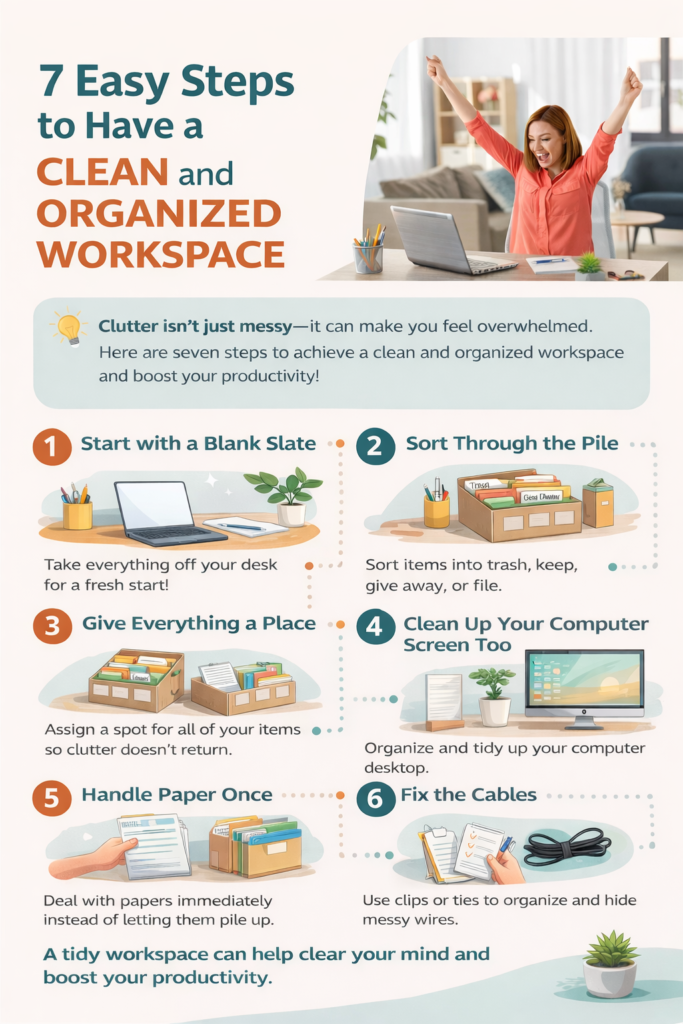
7 Easy Steps to a Clean and Organized Workspace
1. Start with a Blank Slate
Trying to organize a messy desk while stuff is still sitting on it never quite works.
Just take everything off. Every pen, every paper, every coffee mug. Pile it all on the floor or a table nearby. Now you have a blank canvas. Feels lighter already, right? That is your brain taking a deep breath.
2. Sort Through the Pile
Now that your desk is empty, let us deal with the pile. You only need four piles:
- Trash. Throw it away.
- Stuff that belongs to someone else. Give it back.
- Things you use every day. These can go back on the desk.
- Things you use once in a while. These go in a drawer.
Here is a simple rule. If you have not touched it in a month, it does not belong on your desk. Put it away somewhere else.
3. Give Everything a Place
Your brain likes to know where things live. When you always put your phone in the same spot, you stop wasting time looking for it.
Think about your desk in three areas:
- Right in front of you. Just your mouse, keyboard, phone, and whatever you are working on now.
- Off to the side. Stuff you check daily, like a calendar or a notebook.
- Inside the drawers. Everything else.
Try to keep the top of your desk mostly clear. If you can see it, your brain is quietly thinking about it.
4. Clean Up Your Computer Screen Too
Here is something interesting. A messy computer desktop stresses us out almost as much as a messy desk. All those random files create the same mental noise.
Try this for one week. Hide all the icons on your computer desktop. Just get them out of sight. Use your desktop as a temporary spot for files you are actively working on, and clear it out at the end of each day. You will be surprised how much clearer your head feels.
5. Handle Paper Once
Papers pile up because we put them down for later. Then later becomes a week, and suddenly you have a stack staring at you.
Get in the habit of handling things one time. Mail comes in? Open it, deal with it, recycle it, or file it. Do not put it in a pile to deal with later. That pile is where your attention goes to waste.
6. Fix the Cables
This is the easiest win on the list. Tangled cords and wires everywhere just look messy, even if the rest of your desk is clean.
Get some velcro ties or simple clips. Bundle those cables together and tuck them behind your desk or under it. It takes five minutes and it instantly makes your whole space look more together.
7. Take Five Minutes at the End of the Day
Here is the secret to staying organized. It is not about being perfect. It is about a small habit.
Before you shut down for the day, set a timer for five minutes.
- Clear off your main work area.
- Put one thing back where it belongs.
- Leave yourself a note about what you need to do tomorrow.
That is it. Now when you walk in tomorrow morning, you get a clean desk and a clear head right from the start. It is a pretty good way to begin the day.
You do not need a perfect desk. You just need a space that does not work against you. Start with step one today. Even five minutes of clearing off that surface will make a difference.
FAQ’s
The first clean usually takes 30 minutes to an hour. After that, five minutes at the end of each day is enough to keep it that way. The daily habit matters more than the big initial clean.
Start with the surface only. Clear just your main work area first. That one win gives you motivation to tackle a drawer later. Trying to do everything at once often leads to quitting halfway.
Yes. Research suggests digital clutter creates the same mental stress as physical clutter. A clean computer screen helps your brain focus just like a clean desk does. Step four in the post covers this.
Get a small scanner or use a scanning app on your phone. Digitize the paper, label the file clearly, then recycle the physical copy. You keep the information without the pile.
You can only control your side. Keep your personal items contained to your area. Have a quick conversation about shared spaces like the middle of the desk or common supply drawers. Most people are willing to help if you ask calmly.
Bins just hide stuff. If you put things in a bin that you do not use or need, you just created organized clutter. Declutter first, then buy containers for what remains.
The five-minute reset at the end of the day. Nothing else comes close. It takes almost no time and you wake up to a fresh start every single morning. That is step seven.
Yes. Organization is a skill, not a personality trait. These steps are simple behaviors, not personality makeovers. If you follow them, your space will be clean regardless of whether you feel like a naturally organized person.
Also Read:
12 Best Healthy Habits That Release Dopamine
