
Do you ever finish a meal feeling bloated, sluggish, or just off? Maybe you deal with occasional constipation, unpredictable energy slumps, or a stomach that seems to protest for no reason. You are not alone. These common experiences are often your body’s way of sending a signal, a gentle nudge that your digestive system could use some support.
The good news is that finding relief does not require a pharmacy shelf worth of supplements or a restrictive, confusing diet. Often, you can improve digestion naturally by returning to some basic, powerful principles that work with your body’s own intelligent design. It is about giving your internal system what it needs to thrive, so you can feel lighter, more energetic, and more comfortable every day.
This journey starts in your gut microbiome, the vast community of trillions of bacteria living in your intestines. Think of it as a lively garden. When this garden is diverse and balanced, everything runs smoothly. When it is out of balance, you feel the effects. The goal is not to wage war on your gut, but to become its best caretaker.
Let us explore five straightforward, research-backed areas where small, natural changes can make a profound difference in how you feel.
5 Simple Changes Help Improve Digestion Naturally

1. Make Fiber Your Gut’s Best Friend
If your gut bacteria could talk, they would constantly ask for fiber. It is their favorite food. Yet, the article from Harvard Health points out that most of us are not giving them nearly enough. Skimping on fiber is one of the most common reasons people struggle with constipation, irregularity, and that persistent bloated feeling.
Why is fiber so crucial? The experts at Harvard Health put it perfectly:
“Fiber serves as a prebiotic, or food for the good bacteria that live in your gut.”
This is not just a nice idea; eating plenty of fiber is directly associated with increased microbial diversity and a lower risk of gastrointestinal issues. When you eat fiber, you are not just feeding yourself, you are feeding the billions of beneficial microbes that help you digest food, regulate your immune system, and keep inflammation in check.
Articles from Healthline and Citizens Hospital explain that fiber comes in two main types, and both are important for your digestive team:
- Soluble fiber dissolves in water, forming a gel-like substance. It helps slow down digestion, which keeps you fuller longer, and becomes a prime food source for your good gut bacteria. You will find it in foods like oats, beans, lentils, apples, and blueberries.
- Insoluble fiber does not dissolve. It adds bulk to your stool and acts like a broom, helping sweep everything through your intestines to prevent constipation. This type is found in whole wheat, brown rice, leafy greens, and vegetables like cauliflower and potatoes with their skins on.
The Harvard Health article recommends a target of 21 to 38 grams of fiber per day, but if you are starting from a standard low-fiber diet, that number can feel daunting. Do not try to jump there overnight.
Here is how to make it work for you, starting today:
- Focus on “adding,” not “taking away.” Instead of thinking about restriction, think about addition. What can you include in your next meal?
- Start with one simple swap. Choose brown rice instead of white at dinner. Add a handful of spinach to your morning smoothie. Snack on an apple with its skin or a small handful of almonds instead of a processed bag of chips.
- Make your plates more colorful. A simple rule is to aim for at least two different colored vegetables on your lunch and dinner plate. This visual cue naturally increases your fiber and nutrient variety.
- Increase your intake slowly and drink plenty of water. A sudden, large jump in fiber can cause gas and cramping. Add one new high-fiber food every few days, and be sure to drink water throughout the day to help the fiber move through your system comfortably.
What does this look like in practice? Breakfast could be oatmeal with berries and chia seeds. Lunch might be a large salad with mixed greens, chickpeas, and avocado. Dinner could feature roasted salmon with a side of quinoa and steamed broccoli. Each meal consciously includes a fiber source, and it nourishes your gut with every bite.
2. Drink Water For Smooth Digestion
You have just learned about the importance of fiber. Now, meet its essential partner, which is water. Think of fiber as a sponge. Without enough water, that sponge becomes dry, hard, and difficult to move, and that leads to the very constipation you are trying to avoid. Bali International Hospital notes that water is essential for digestion because it helps break down food so your body can absorb nutrients.
Healthline explains that water is the lubricant and transport system that makes your entire digestive process possible. It helps dissolve food, activates digestive enzymes, and transports nutrients to your cells. When you are even mildly dehydrated, the entire process can slow down, which leads to bloating, cramps, and that stuck feeling.
So, how much is enough? Harvard Health and San Antonio Gastroenterology Associates (Gastroconsa) provide a general guideline, so aim for four to six cups of water per day as a baseline. However, your personal needs will rise if you are physically active, live in a hot climate, or are increasing your fiber intake. Your body will give you signals, such as thirst, dark yellow urine, fatigue, or a headache, and these are clear signs it is time to drink up.
Practical steps to take that make hydration effortless:
- Begin your day with water. Before your coffee or tea, drink a full glass of water. This rehydrates you after a night’s sleep and gently wakes up your digestive system.
- Eat your water. Many whole foods are packed with water. Cucumbers, celery, zucchini, watermelon, strawberries, and soups are fantastic ways to boost your hydration through food.
- Carry a dedicated water bottle. Having water visually present and within reach makes you far more likely to sip throughout the day. Choose a bottle you like the look and feel of.
- Infuse flavor naturally. If plain water is unappealing, add natural flavor. Bali International Hospital suggests slices of lemon, lime, cucumber, or a few sprigs of fresh mint. Herbal teas like peppermint or ginger, served hot or cold, also count toward your fluid intake, and they offer extra digestive benefits.
- Link drinking to a daily habit. Tie a glass of water to an existing routine. Drink a glass after you brush your teeth, before each meal, or every time you get up from your desk.
The key is consistency. Small, regular sips throughout the day are more effective for your digestion, and for your cells, than chugging two giant glasses all at once.
3. Welcome Helpful Bacteria With Probiotic Foods
You have been feeding your gut bacteria with fiber. Now, let us talk about adding more of the good bacteria themselves. These are called probiotics, and they are live, beneficial microorganisms.
Far North Surgery describes them as the healthy bacteria and yeasts that help combat the consequences of stress and poor diet, and they enhance nutrient absorption while supporting your immune system.
Imagine your gut as a neighborhood. Probiotics are the friendly, helpful neighbors who keep the streets clean, support the community, and make it hard for troublesome characters to move in.
By consuming probiotic-rich foods, you are directly adding these helpful residents to your gut community. Bali International Hospital adds that including these foods regularly can help restore balance to your gut microbiome.
The beauty is that probiotics are found in delicious, traditionally prepared fermented foods. You do not necessarily need a pill, as you can find them at your grocery store.
To invite these helpful allies into your diet:
- Pick one new probiotic food to try. The variety can be fun to explore.
- Yogurt & Kefir: Look for labels that say “contains live and active cultures.” Plain, unsweetened versions are best.
- Sauerkraut & Kimchi: These are fermented cabbages. Ensure you buy them from the refrigerated section and that the label says “naturally fermented” or “raw” to guarantee the live cultures are present.
- Kombucha: A fizzy fermented tea drink. Be mindful of the sugar content in some commercial brands.
- Miso & Tempeh: Staple fermented foods. Bali International Hospital specifically highlights tempeh as a local favorite rich in probiotics.
- Start with a small serving. If your gut is not used to fermented foods, begin with a tablespoon of sauerkraut as a condiment or a small cup of kefir. This allows your system to adjust.
- Consistency is key. A small, daily serving is more effective than a large amount once a week. Try adding a spoonful of yogurt to your breakfast or a side of kimchi with your lunch.
Remember, the fiber you are eating, which are the prebiotics, is the food for these probiotics. By combining both, you are creating a powerful, self-sustaining cycle of good gut health.
4. Slow Down and Chew Your Food Properly
In our fast-paced world, we often treat eating as a task to hurry through. We eat at our desks, in the car, or while scrolling through our phones. This rush comes at a direct cost to our digestion because digestion begins in your mouth, not your stomach.
Citizens Hospital explains that your nervous system directly influences digestion. Eating in a relaxed state activates the system that optimizes digestive function. When you are stressed or eating quickly, your body actually prioritizes other functions over digestion. Furthermore, Healthline states that chewing is your first step in breaking down food. It increases the surface area of what you have eaten, which then allows your digestive enzymes efficient access to nutrients.
The simple, physical act of chewing is the first and most mechanical step of breaking down your food. Your saliva contains digestive enzymes that start processing carbohydrates and fats. When you chew thoroughly, you create smaller, more manageable food particles and coat them in this enzyme-rich saliva.
This gives your stomach a huge head start, making its job much easier and more efficient. Conversely, swallowing large, poorly chewed chunks forces your stomach to work overtime, and that can lead to bloating, gas, and indigestion.
Build this foundational habit with a few conscious shifts:
- Put your utensil down between bites. This simple action forces a pause and breaks the automatic cycle of loading your next forkful while still chewing the last.
- Chew each mouthful 20-30 times. Count for a few meals until you get a sense of what it feels like to chew your food until it is a near-liquid paste. This is especially important for nuts, seeds, and raw vegetables.
- Create a calm eating environment. Try to eat at least one meal a day sitting at a table and without the distraction of screens. Focus on the colors, smells, flavors, and textures of your food.
- Take three deep breaths before you start eating. This tiny ritual signals to your nervous system that it is safe to shift into “rest and digest” mode.
This is not about turning every snack into a meditation retreat, but it is about bringing a little more awareness to a fundamental act of self-care. You might be surprised at how much more you enjoy your food and how much better you feel afterward.
5. Get Moving To Keep Things Moving
The benefits of regular physical activity extend far beyond your heart and muscles, and they reach deep into your digestive tract. A sedentary lifestyle, which is characterized by long periods of sitting, is a common contributor to sluggish digestion and constipation. When you move your body, you also help move things along inside.
San Antonio Gastroenterology Associates (Gastroconsa) notes that regular exercise helps food move through your digestive system faster, and it reduces the risk of nausea, bloating, and constipation. Harvard Health supports this, citing a systematic review that found consistent exercise has a positive effect on your gut microbiota. They note that people who are sedentary have different gut bacteria characteristics than those who are active.
Exercise stimulates the natural wave-like muscle contractions in your intestines, known as peristalsis. This is what propels food through your digestive system. By enhancing these contractions, physical activity helps prevent waste from stagnating. Exercise also reduces stress, which, as we have seen, is a direct benefit for your gut-brain axis.
The best part is that you do not need to train for a marathon. Consistency with moderate movement is the goal.
You can start supporting your digestion with simple, enjoyable activity:
- Commit to a daily walk. This is one of the most underrated and effective digestive aids. Aim for a 20-30 minute walk most days of the week.
- Take a short walk after meals. Gastroconsa specifically suggests taking a walk after meals. A gentle, 10-15 minute stroll after eating is particularly powerful.
- Find movement you genuinely enjoy. If you dread it, you will not stick with it. This could be cycling, swimming, dancing, gardening, or yoga. Citizens Hospital mentions that yoga poses that twist the abdomen can be particularly beneficial.
- Break up long periods of sitting. Set a timer to stand up, stretch, and walk around for five minutes every hour if you have a desk job.
The message is to get your body moving in ways that feel good. Your gut will thank you for the internal massage and the improved circulation.
Your Path Forward: Start With One Simple Change
We have covered five powerful, natural areas where you can take action to improve digestion naturally, and these include prioritizing fiber, as emphasized by Harvard Health, drinking enough water per Bali International Hospital, enjoying probiotic foods like those suggested by Far North Surgery, chewing mindfully, a practice explained by Citizens Hospital, and moving your body regularly as supported by San Antonio Gastroenterology Associates.
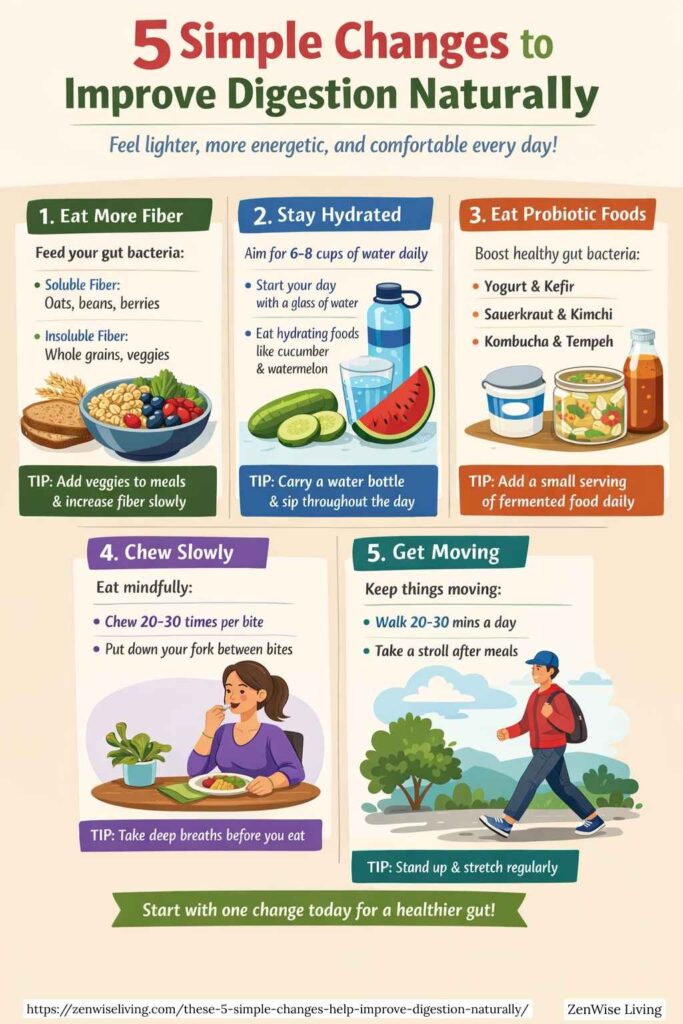
Looking at this list, you might feel inspired but also wondering, “Where do I possibly start?”
The most empowering approach is to choose just one. Trying to change everything at once is a recipe for overwhelm and burnout. True, lasting change is built on small, consistent victories.
Scan the list above. Which change feels the most doable, interesting, or appealing to you right now?
- Is it swapping your afternoon snack for a piece of fruit and a handful of nuts?
- Is it filling up a water bottle first thing in the morning?
- Is it buying a small jar of sauerkraut to try on your sandwich?
- Is it committing to chewing your dinner more thoroughly tonight?
- Is it taking a 10-minute walk after your largest meal?
Pick one. Focus on it for a week or two. Let it become a natural, effortless part of your routine. Celebrate that success. Then, and only then, consider layering in a second change.
Your digestive health is a cornerstone of your overall well-being, and it influences your energy, mood, and immunity. By making these small, natural investments in your gut, you are investing in a more comfortable, vibrant, and resilient you. You have the power to improve digestion naturally. Start today, with one simple, kind step.
Common Questions About How To Improve Digestion Naturally
You can improve digestion naturally by focusing on key habits like eating more fiber, drinking enough water, and including probiotic foods. Support these efforts by chewing your food thoroughly and staying active with regular movement.
The fastest way to support your digestive system is to focus on simple, natural habits. Prioritize fiber-rich whole foods, stay well-hydrated, include probiotic foods, and add regular movement like walking. Consistency with these changes helps create an optimal environment for your gut to reset and thrive.
Signs of poor gut health often start with digestive discomfort, like persistent bloating, gas, or irregular bowel movements. You might also experience broader issues such as unexplained fatigue, low mood, and intense sugar cravings, which are all connected to your gut’s delicate ecosystem.
Based on the research, it’s helpful to limit processed foods, as Gastroconsa notes they often contain ingredients that can irritate your system. Try cutting back on added sugars, which the same source says can upset your gut’s bacterial balance. Also, avoid late-night meals, as Healthline explains eating right before bed can slow digestion.
Foods that are very high in fat, like deep-fried items, can be slow and difficult for your system to break down. Stimulants such as coffee and alcohol, along with very spicy or acidic foods, are also common irritants that can disrupt comfortable digestion for many people.
Read More:
14 Effective Healthy Habits to Lose Weight
5 Healthy Habits to Live Longer That Are Surprisingly Simple
