
That familiar twist in your stomach when a request pops up. Your mind starts racing as you look at your packed schedule. You know the right answer is no, but the word “yes” escapes almost on its own. What follows is a familiar heaviness, a mix of dread for the new task and a confusing guilt for even considering a refusal.
If this scenario hits close to home, please know you are in good company. We often agree to things to avoid feeling guilty, rude, or like we are disappointing someone. But this automatic “yes” comes with a high price tag: burnout, resentment, and a life that feels cluttered with obligations that are not your own.
What if you could change this pattern? This is not about becoming selfish or harsh. It is about learning to say no without guilt as a necessary and respectful act of self-care. It is a skill, and like any skill, it can be learned and strengthened.
By the end of this guide, you will understand the specific science behind why refusal feels so difficult and you will have five compassionate, practical strategies to protect your time and energy.
The Science Behind Your Struggle and How To Say No Without Guilt

To change a reaction, we must first understand it. That knot in your stomach is not a personal failing. It is a complex mix of neuroscience and deep social wiring. Let us break down why saying no triggers such a powerful emotional and physical response.
Understanding Guilt And Shame
First, we must separate guilt from its close relative, shame. They feel similar, but psychologists draw a clear and important line between them.
- Shame is the feeling that “I am bad.” It is a negative judgment about your core self.
- Guilt is the feeling that “I did something bad,” or might do something bad, like saying no. It is focused on a specific action or choice.
This distinction is crucial. The 2020 study by Ishikawa and Uchiyama, “Guilt and shame: an update,” confirms that guilt is typically tied to specific behaviors and their social consequences, while shame is a broader evaluation of the self. Why does this matter for you? When you feel bad about declining a request, it is usually guilt, not shame. You are worried about the action of saying no and its potential impact on the relationship.
This means the feeling is about a decision you can control, not your fundamental worth. You can learn to manage the choice without self condemnation.
The Neuroscience Of A Guilt Reaction
So where does this guilty feeling actually come from? It is not just in your mind, it is in your brain’s physical architecture. Scientists have mapped the specific neural pathways that activate when we experience guilt.
Think of guilt as your built-in social alarm system. When you consider an action that might strain a social connection, like turning down a friend or colleague, this alarm sounds. It is a physical reaction. Your brain is sending a signal: “Warning. This action could disrupt an important social bond.”
This is not just theory. In a press release for their groundbreaking study, the research team at the University of Barcelona stated their key finding:
“We’ve identified distinct brain pathways that guide behaviors driven by guilt.”
This finding changes everything. It means the pang of guilt you feel is a real, measurable, biological event. It is not you being “too nice” or “weak.” It is your ancient, hardwired social brain doing its job to preserve connection. The challenge in our modern world is that this alarm now sounds for non-emergencies, like declining an optional meeting or skipping a social event to rest.
Guilt As A Social Signal
Our brains are wired for connection and belonging. For most of human history, separation from the group could mean danger. Saying “no” can feel, on a primal level, like a step toward separation. That is why the guilt alarm sounds so loudly, it is trying to steer you back toward the “safe” choice of saying “yes” to maintain harmony.
This wiring is so strong that others can unconsciously trigger it through what is called a “guilt appeal.” The 2023 meta-analysis by Zhang and colleagues, “When guilt works: a comprehensive meta analysis of guilt appeals,” shows how common this is in communication. A phrase like, “I guess I’ll just have to do it all myself,” or “Everyone else is helping out,” is designed to activate that specific neural pathway in your brain to influence your behavior.
When you understand this, you can start to see the feeling for what it is: a signal, not a command. You can acknowledge the alert, you can notice your brain is worried about social cohesion, without having to blindly obey it by saying “yes.”
Feeling guilt does not mean you have done something wrong. It often means you care about the relationship. The skill is learning to honor that care while also honoring your own limits. Now, let us build that skill with five concrete strategies.
How To Rewire Your Response And Learn To Say No Without Guilt
Knowing the science is the first step. Now, let us translate that knowledge into action. These five strategies are your personal toolkit. They are designed to help you navigate the guilt response with intention and clarity, so you can communicate your boundaries with confidence.
Think of them as different tools for different situations. You do not need to use them all at once. Start with the one that feels most manageable for you and build from there.
1. Buy Time With A Delayed Response
Often, the most difficult part is the moment of the request itself. The pressure builds quickly, and saying “yes” can feel like the fastest way to relieve the social tension and quiet your internal guilt alarm. This creates a cycle of automatic, resentful agreements.
Instead of reacting instantly, give yourself the gift of a pause. Creating a buffer between the request and your answer is powerful because it disrupts the impulsive guilt-to-yes cycle. It allows your brain’s prefrontal cortex—the rational, decision-making center—to come back online so you can evaluate the request calmly.
How to Do It:
The goal is simple: create space without committing. Use these polite scripts to give yourself that crucial breathing room:
- “Let me check my calendar and get back to you this afternoon.”
- “I need to think about my current commitments before I can give you a solid answer. Can I let you know tomorrow?”
- “I cannot answer right now. I will circle back once I have had a chance to look at my schedule.”
Why This Works:
This approach is recommended by therapists like Kobie Allison, LPCA. In her article on mastering the art of saying no, she notes that this pause allows you to evaluate whether a request aligns with your true priorities, moving you from an impulsive reaction to an intentional decision.
Your Key Takeaway: A pause is not a refusal. It is the essential step that prevents an automatic, resentful “yes.”
2. Offer An Alternative Solution
You might worry that a flat “no” feels like you are rejecting the person themselves, which can heighten feelings of guilt. You want to be helpful and maintain the relationship, but the specific request just does not work.
This strategy focuses on preserving the connection while honoring your limit. By saying no to the request as framed but offering a different form of support, you address the core social concern. You show you still value the person and their need.
Putting It Into Practice:
Frame your response to show care while protecting your boundary. For example:
- “I cannot take on the full project management role, but I am happy to review the plan and give my notes next week.”
- “I am not available to volunteer all day Saturday, but I could handle the morning shift to help you get started.”
- “I cannot commit to a weekly call, but let us schedule a check in once a month.”
The Psychology Behind It:
This aligns with what psychologists call “reparative behavior,” a healthy way to manage guilt. Writer and researcher Courtney Ackerman, in a guide for Positive Psychology, highlights this as a powerful method to maintain relationships while honoring your limits. You are solving for their need in a way that also respects your own, directly reducing lingering guilty feelings. Remember, you are saying “no” to the specific demand, not to the person or the relationship.
3. How To Say No Without Guilt Using “I” Statements
When you use phrases like “I can’t,” it often invites the follow-up question, “Why not?” This pushes you into defensive justifications. Blaming external factors can feel weak and is often easy for others to challenge, leaving you feeling cornered.
A more empowered approach is to use a clear, firm, and polite “I” statement. This centers your choice and ownership of the decision without apology or lengthy justification. It communicates that your boundary is about your needs and priorities, not a topic for negotiation.
Actionable Scripts:
Own your decision with clarity and respect by practicing phrases like:
- “I am not taking on any new client work this quarter.”
- “I have decided to keep my weekends free for family time.”
- “I do not have the capacity to give that the attention it deserves right now.”
What Makes It Effective:
“I” statements are the cornerstone of assertive communication. The clinical team at Bishop’s Counseling emphasizes in their guide for women that these statements are direct and respectful, helping to set a clear boundary. When you say “I am not” instead of “I can’t,” you shift from appearing helpless to being in control of your choices. Your honest need, stated clearly from your perspective, is a complete and valid reason.
4. Set Proactive Expectations
Do you find yourself facing the same type of draining requests over and over, leading to repeated cycles of guilt and uncomfortable negotiation? Constantly being on the defensive is exhausting.
A strategic shift is to get ahead of the requests. By proactively communicating your priorities and general boundaries to your social and professional circles, you manage expectations and prevent many guilt-inducing requests before they even happen.
Implementing This Strategy:
You can make your focused priorities known in a low-key, professional way. Consider these examples:
- At Work: “Just a heads up, my team is dedicating all of Q3 to the project launch, so our availability for new initiatives will be very limited.”
- For Your Time: “I am focusing on deep work in the mornings, so I have scheduled ‘no meeting’ blocks until noon on my calendar.”
- Personally: “I am making an effort to be fully offline after 7 PM to recharge, so I will respond to messages the next morning.”
The Power of Prevention:
This is boundary setting at its most effective because it is preventative. The contributor from the Harris County Public Library blog points out in an article on saying no that setting clear expectations in advance prevents misunderstandings. It dramatically reduces the number of situations where you need to deliver a difficult “no” in the moment. You train people how to treat you by consistently and calmly communicating your priorities first.
5. Reframe Your “No” As A “Yes”
Sometimes, the biggest hurdle is our own perspective. If you still see “no” as a negative, depriving, or selfish word, that mental frame will directly fuel your guilt.
The final strategy involves a simple but profound mindshift: actively practice cognitive reframing. Recognize that every single “no” is simultaneously a “yes” to something else you value. This technique does not just change your words; it changes the emotional pathway in your brain by focusing on the positive gain of your choice.
The Practice:
Before you deliver your answer, take a second to complete this sentence silently: “By saying no to this, I am saying YES to…”
- Saying no to a last-minute assignment is saying YES to the quality of your existing work and your planned evening of rest.
- Saying no to a draining social event is saying YES to your need for quiet recovery and your energy for tomorrow.
- Saying no to taking on a colleague’s task is saying YES to your own projects and professional goals.
Connecting to the Science:
This strategy directly engages with the neuroscience we discussed earlier. The work by the University of Barcelona research team on guilt driven behaviors implies our actions are guided by competing neural signals. When you consciously reinforce the positive value you are choosing (your “yes”), you strengthen that neural pathway. You are not just rejecting; you are actively and intentionally choosing. This transforms the act from one of loss to one of purposeful gain. Your “no,” therefore, has a powerful, positive purpose: it is the necessary action that protects your more important “yes.”
Your Journey To Lighter Living
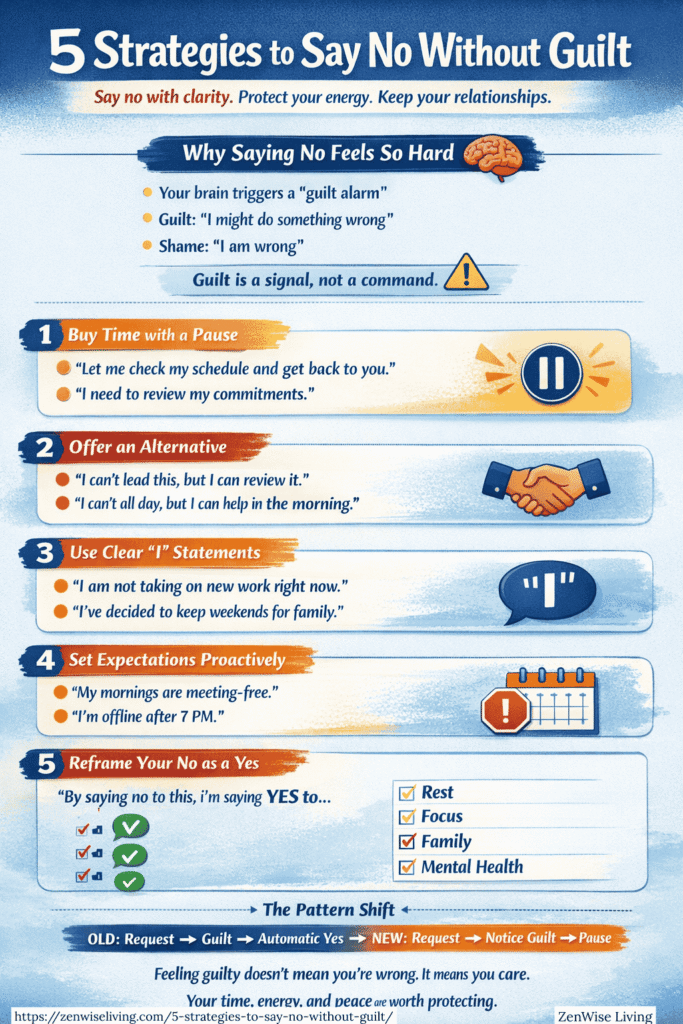
Learning to say no without guilt is a journey, not a one time event. It is the practice of building a new habit in your brain. Right now, the well worn path is: Request, then Guilt Alarm, then Automatic “Yes.” Your work is to start carving a new path: Request, then Notice the Alarm, then Pause, then Choose Your Intentional Response.
You now have the map and the tools:
- Buy Time to quiet the initial alarm.
- Offer an Alternative to preserve connection.
- Use “I” Statements to own your decision with confidence.
- Set Expectations to prevent recurring requests.
- Reframe Your “No” as a committed “Yes” to what matters most.
The feeling of guilt might not vanish overnight, and that is okay. The goal is not to feel nothing. The goal is to hear that internal signal, understand where it is coming from, and then, with compassion for yourself and others, choose the action that aligns with your values and priorities anyway.
Start small. Look at your week ahead. Identify one low stakes request where you can practice just one of these strategies. Maybe it is pausing before agreeing to a meeting, or using an “I” statement with a family member.
Each time you do this, you weaken the old, automatic pathway and strengthen the new, intentional one. You are not building walls, you are drawing a clear, respectful map of your garden, so you can tend to what is inside it properly. Your time, your energy, and your peace are worth protecting.
You can do this.
Common Questions About How To Say No Without Guilt
Guilt is a hardwired social alarm. Specific brain pathways activate, fearing that saying “no” threatens social connection. It’s a biological signal, not a sign you’re doing something wrong.
Shame means “I am bad,” while guilt means “I did something bad.” Guilt over saying no is about the action, not your core worth, which helps you manage the feeling without self-condemnation.
Start with the delayed response. Use a script like, “Let me check my calendar and get back to you.” This pause lets your rational brain engage, preventing automatic, resentful agreements.
Use the “Offer an Alternative” strategy. Decline the specific request but provide another way to help, such as, “I can’t do X, but I can do Y.” This addresses the social concern and maintains the connection.
Use clear “I” statements, such as, “I am not taking on new projects.” This centers your boundary as a personal policy. If pushed, calmly repeat your statement—your honest need is a complete reason.
Read More:
How to Improve Concentration and Beat Decision Fatigue
How Digital Distraction Kills Focus (And Exactly How to Stop It)
How Taming Daily Stress is Your Secret Weapon for a Longer, Healthier Life
