
If you’ve ever started a weight loss plan feeling hopeful, only to find yourself surrounded by confusing rules and quick fixes that don’t last, you know that approach doesn’t work. The good news is, you don’t need another strict diet. What truly works is something different and more sustainable.
Leading health experts from the Centers for Disease Control and Prevention (CDC) and the Mayo Clinic point to a simple truth: lasting results come from practical lifestyle changes, not short-term restrictions.
This guide brings together the science from trusted sources into one clear plan. We have distilled the research into 14 foundational healthy habits to lose weight.
Think of these not as a rigid diet, but as a practical toolkit for creating a healthier, more energetic life. Let us build that life together.
14 Effective Healthy Habits to Lose Weight

The following habits are your actionable plan, grouped into four key pillars of success: Mindset, Nutrition, Movement, and Lifestyle. Focus on mastering one pillar, or even one single habit, at a time.
Start with Your Mindset
1. Define Your Personal “Why”
Your journey needs an anchor, a reason that goes beyond a number on a scale. The CDC calls this the first step: understanding your “why.” Is it to have more energy for your children, to improve a specific health marker, or to feel stronger for an upcoming adventure?
Your first step is simple: Grab a piece of paper or your phone and write down your top three personal reasons. Be specific. Instead of “get healthy,” try “lower my blood pressure so I can reduce medication” or “build stamina to go on a hiking trip.” Place this list where you will see it daily, like on your bathroom mirror or refrigerator. This list is your compass on tough days.
Research shows that connecting to a deep personal motive increases your commitment. The CDC emphasizes the powerful impact of a modest goal, stating:
“If you are not at a healthy weight, even modest weight loss can help improve your blood pressure, cholesterol, and blood sugar levels.”
– CDC
For someone weighing 200 pounds, a 5% reduction is only 10 pounds, an achievement that can lower the risk of chronic diseases like heart disease and type 2 diabetes. Your “why” powers you toward these meaningful wins.
2. Set Specific, Action-Oriented Goals
Vague goals lead to vague results. Telling yourself to “eat better” or “exercise more” is not a clear plan. The Mayo Clinic recommends setting two types of goals: action goals and outcome goals.
An outcome goal is what you want to achieve, like “lose 10 pounds.” An action goal is how you will get there. The action goal is the habit you can control every single day.
Here is how to make it work: Transform your vague intentions into specific, time-bound actions.
- Instead of: “I will eat better.” Try: “I will include a serving of vegetables with my dinner at least four nights this week.”
- Instead of: “I will exercise more.” Try: “I will take a 20-minute walk on my lunch break every Monday, Wednesday, and Friday.”
Setting unrealistic goals can lead to frustration. The Mayo Clinic provides a safe and effective benchmark: aim to lose 1 to 2 pounds per week.
This pace is sustainable and is linked to long-term success. Your action goals are the stepping stones that make this steady progress possible.
3. Track Your Habits Without Judgment
Awareness is the first step toward change. Self-monitoring is a powerful technique, and the National Institutes of Health (NIH) identifies it as a cornerstone of successful behavioral change. This is not about counting every calorie forever; it is about observing your patterns with curiosity, not criticism.
To start, try this: For three to five days, keep a simple log. You can use a notebook or an app. Track just a couple of things:
- What and when you eat and drink.
- Your physical activity.
- Your sleep hours.
Do not judge what you see. The goal is to spot patterns. Do you snack late at night? Do you skip breakfast and get ravenous later? Do you sleep less on days you crave more sugar? This data is your personal blueprint for change.
What is your first actionable goal? Choose one from Habit 2 and write it down now.
Transform Your Daily Nutrition
What you eat is fundamental, but it does not have to be complicated. These habits focus on simple, powerful shifts in your daily eating patterns that add up to major results.
4. Drink Water First
Often, our bodies mistake thirst for hunger. Making water your primary beverage is one of the simplest and most effective healthy habits to lose weight.
Put it into practice today:
- Start your day with a full glass of water.
- Keep a reusable water bottle on your desk or in your bag.
- Drink a glass of water 20-30 minutes before each meal.
A Healthline review of the science notes that drinking water can temporarily boost your metabolism. More importantly, one study showed that drinking water before meals helped people eat fewer calories.
By staying hydrated, you help your body function optimally and naturally manage hunger.
5. Fill Half Your Plate with Plants
This is one of the most impactful changes you can make. Vegetables, fruits, beans, and whole grains should be the stars of your meals.
The American Institute for Cancer Research (AICR) states it perfectly:
“Fruits, vegetables, beans and whole grains are high in vitamins, minerals and fiber to keep you healthy and feeling full. They’re also low in calories.”
Your simple step: Use the Harvard “Healthy Eating Plate” as your visual guide. Imagine your plate divided:
- Half: Fill this with colorful vegetables and fruits.
- One Quarter: Fill this with lean protein (like chicken, fish, beans, or tofu).
- One Quarter: Fill this with whole grains (like brown rice, quinoa, or whole-wheat bread).
This method naturally controls portions and ensures you get volume, nutrients, and filling fiber with fewer calories.
6. Choose Whole Foods Over Processed Ones
Processed foods are often engineered to make you overeat. They are typically high in added sugars, unhealthy fats, and salt, but low in the fiber and nutrients that satisfy you. Healthline and Harvard Health both emphasize the importance of basing your diet on whole, single-ingredient foods.
Make this simple swap most of the time.
- Instead of a sugary cereal bar, have a bowl of oatmeal with fresh berries.
- Instead of chicken nuggets, bake or grill a chicken breast.
- Instead of chips, snack on a handful of almonds and an apple.
- Instead of soda, drink sparkling water with a squeeze of lime.
Whole foods are more nutrient-dense and filling. Because they are less “hyper-palatable” than processed foods, you are more likely to eat until you are comfortably full, not stuffed.
7. Control Your Portions
You can eat healthy foods and still overeat. Portion awareness is a key skill. The AICR notes that strategies focused on portion control can lead to meaningful weight loss over time.
Here are a few ways to start:
- Use smaller plates. This makes a moderate serving look plentiful.
- Serve your plate in the kitchen. Do not put serving bowls of food on the table, which can lead to unconscious second helpings.
- Read labels. Check the Nutrition Facts panel to understand what one actual serving size is.
It takes about 20 minutes for your brain to receive “fullness” signals from your stomach. Eating from a smaller plate and slowing down helps align your eating with your body’s natural cues, preventing overeating before you feel it.
Can you try the “Half-Plate” rule at your very next meal?
8. Eat Mindfully
Mindful eating is about being present with your food. It is the opposite of eating in the car, at your desk, or in front of the TV. The Mayo Clinic highlights that paying attention helps you enjoy your food more and recognize when you are full.
Try this at your next meal:
- Eat seated at a table, from a plate, whenever possible.
- Put your fork down between bites.
- Chew your food thoroughly and savor the taste and texture.
- Ask yourself halfway through the meal, “Am I still actually hungry?”
When you are distracted, you are more likely to eat quickly and miss your body’s satiety signals, often leading to consuming more calories than you need. Mindful eating puts you back in control of the experience.
Build Consistent Movement
Physical activity is the partner to healthy nutrition. It burns calories, improves mood, and is absolutely essential for maintaining weight loss. The NIH calls regular physical activity one of the best predictors of long-term weight management success. In fact, the NIH notes that:
“one of the best predictors of success in the long-term management of overweight and obesity is the ability to develop and sustain an exercise program.”
– NIH
This underscores why the habits in this section are so crucial.
9. Find Activities You Enjoy
If you hate running, do not run. The CDC advises that the best physical activity is the one you will actually do consistently. Exercise should not feel like punishment.
A great way to begin is to make a list of physical activities that sound even remotely fun. Do not limit yourself to the gym.
- Dancing
- Hiking
- Swimming
- Gardening
- Cycling
- Playing a recreational sport
- Brisk walking while listening to a podcast or audiobook
Your mission is to experiment until you find something you look forward to.
10. Move More Throughout the Day
Your overall daily movement, separate from dedicated exercise, is called Non-Exercise Activity Thermogenesis (NEAT). The Mayo Clinic points out that boosting your NEAT is a fantastic way to burn extra calories without “working out.”
Look for tiny opportunities to move.
- Take the stairs instead of the elevator.
- Park in the farthest spot in the lot.
- Walk around your home or office during phone calls.
- Set a timer to stand up and stretch or walk for 5 minutes every hour.
- Do simple bodyweight exercises like calf raises while brushing your teeth.
These micro-movements add up to a significant calorie burn over a week.
11. Commit to Regular Cardio Exercise
For directly burning calories and improving heart health, steady aerobic exercise is incredibly effective. The NIH states that activities like brisk walking are excellent for losing body fat.
A clear target to aim for is the common guideline recommended by health authorities: aim for at least 150 minutes of moderate-intensity aerobic activity per week. This breaks down into very manageable pieces:
- 30 minutes of brisk walking, 5 days a week.
- Three 50-minute sessions of swimming, cycling, or dancing.
Start where you are. If 30 minutes is too much, start with three 10-minute walks per day. Consistency is far more important than intensity.
12. Incorporate Strength Training
This habit is non-negotiable for a healthy metabolism. When you lose weight, you can lose both fat and muscle. Strength training preserves and builds that calorie-burning muscle tissue.
The NIH explains that muscle mass is metabolically active. By preserving it through strength training, you help maintain your metabolic rate as you lose weight. The AICR also recommends it to build muscle and burn calories.
Your plan should include strength training exercises for all major muscle groups at least two times per week. This does not require a gym membership.
- Use resistance bands.
- Do bodyweight exercises like squats, lunges, push-ups (against a wall or on your knees is fine), and planks.
- Use light dumbbells or even household items like water bottles.
Which new movement habit can you schedule into your calendar this week? Pick one from Habits 9-12.
Support Your Overall Lifestyle
Your weight is influenced by more than just diet and exercise. These final habits address the crucial lifestyle factors that can make or break your success.
13. Prioritize Sleep and Manage Stress
Sleep and stress are two sides of the same coin, and both have a direct impact on your weight.
Healthline reviews show that sleep deprivation disrupts your appetite hormones. It increases ghrelin (the “hunger hormone”) and decreases leptin (the “fullness hormone”), leading to stronger cravings, especially for high-carbohydrate and high-fat foods.
For better sleep, focus on consistency:
- Stick to a consistent sleep schedule, even on weekends.
- Create a relaxing bedtime routine, like reading or taking a warm bath.
- Keep your bedroom dark, cool, and quiet.
The Mayo Clinic links high stress to the difficulty of making lasting healthy changes. When stressed, people often turn to food for comfort, a behavior known as emotional eating.
To manage stress, build in small pauses:
- Schedule short, five-minute breaks for deep breathing or meditation.
- Go for a brisk walk to clear your head.
- Write down your worries in a journal to get them out of your head.
14. Plan for Setbacks and Build Support
No journey is a straight line. Expecting perfection is a recipe for giving up. The CDC wisely advises that “occasional setbacks happen… get back on track as quickly as possible.”
Furthermore, the CDC highlights the importance of finding support. You do not have to do this alone.
Actionable Tip: Your strategy should have two parts.
- First, plan for challenges. Think ahead. If you have a big dinner party, plan your day accordingly. If you miss a workout, just get back to it the next day. One off-choice is not a failure; it is data.
- Second, build your support system. Identify one or two people you trust. Share your goals with them and ask for their encouragement. This could be a friend, family member, or even an online community with similar goals. Having someone to check in with makes you more accountable and less isolated.
Making Your Healthy Habits Last
You now have 14 powerful, science-backed tools. The final step is to turn them into your lifestyle. Remember, this is not about doing all 14 at once tomorrow. That is a guaranteed path to burnout.
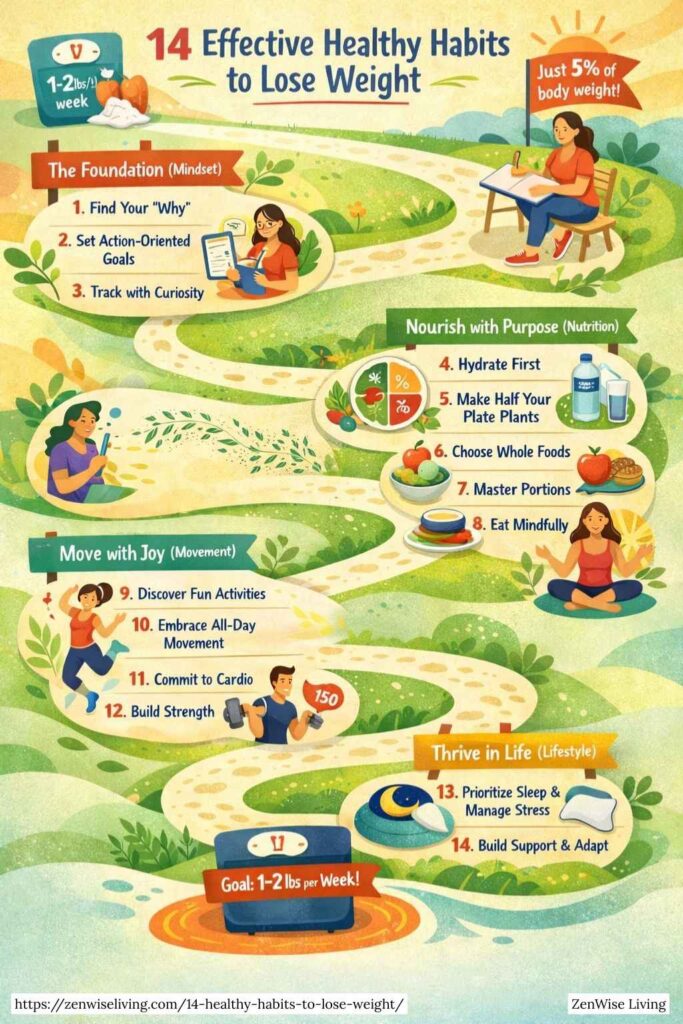
Your roadmap to success:
- Revisit Your “Why” (Habit 1). This is your true north. Keep it close.
- Start Extremely Small. Choose one single habit from this list that feels achievable. Maybe it is drinking water first (Habit 4) or taking a 10-minute walk (Habit 11). Master it for one week.
- Add, Do Not Replace. Next week, keep your first habit and add one more. Slow, steady stacking is how you build a resilient system that lasts.
- Be Your Own Best Friend. Talk to yourself with kindness. Celebrate every small win. If you have a tough day, acknowledge it, learn from it, and then gently steer yourself back.
Sustainable weight loss is built on healthy habits to lose weight that you integrate into your life, not a temporary diet you endure. You have the knowledge and the plan. You are capable of making these changes.
Your journey starts with a single, small step. Which one will you take today?
Common Questions About Healthy Habits to Lose Weight
Two powerful places to start are moving your body for about 150 minutes each week and filling half your plate with fruits and vegetables. For steady, sustainable results, a healthy goal is to lose 1 to 2 pounds per week.
The healthiest way to lose weight is to build a supportive lifestyle focused on good nutrition, regular activity, and quality sleep. Lasting success comes from a steady pace, aiming to lose about 1 to 2 pounds per week, which gives your body and habits time to adjust.
Drinking water can support weight loss by helping to manage hunger and is a great zero-calorie replacement for sugary drinks. While it is a helpful tool, it works best as part of your broader healthy habits.
For weight loss, it helps to cut back on heavily processed items like sugary drinks, baked sweets, and refined grains. Shifting your focus toward whole, nutrient-dense foods instead naturally supports your goals.
Yes, you can enjoy rice while losing weight. Opt for whole grains like brown rice for more fiber, and be mindful of your portion size, aiming for about half a cup cooked. For a balanced meal, pair it with lean protein and plenty of vegetables.
Read More:
12 Best Healthy Habits That Release Dopamine
5 Healthy Habits to Live Longer That Are Surprisingly Simple
