
Do you ever sit down to work, only to find your mind has already left the building, chasing five different thoughts at once? For many with ADHD, this is not just a frustrating moment. It is a daily puzzle where focus feels just out of reach, and the simple act of completing a task can seem like a monumental challenge.
The old story says this is about laziness or a lack of willpower. But science tells us a different story. The real challenge is often about managing your attention, not just having more of it.
The good news is you can build real, practical skills to work with your brain’s unique wiring. This guide is about seven science-backed ways to improve focus with ADHD, turning daily struggles into manageable steps.
Let’s get started.
- 7 Ways to Improve Focus with ADHD
- Your Focus Toolkit is Ready
- Common Questions About Ways to Improve Focus with ADHD
7 Ways to Improve Focus with ADHD

1. Design a Distraction-Free Zone
Before you even try to focus, look around. Your environment is your first and most powerful tool. The ADHD brain is primed to seek out new stimuli, which means a cluttered desk or a buzzing phone is not just a nuisance. It is an irresistible invitation to procrastinate.
The goal is not to create a sterile room, but a space where you control the stimulation. Start by clearing the visual noise. A desk covered in papers, knick-knacks, and old coffee cups gives your brain a hundred different places to wander. Put everything away except the one thing you are working on.
Research highlighted by GoodRx consistently shows that removing unnecessary distractions is a foundational step for concentration.
Next, conquer digital chaos. Notifications are the enemy of deep focus. When you need to concentrate, turn your phone to silent and place it in another room. On your computer, use website blockers to temporarily restrict access to social media or news sites during your work blocks. This external guardrail helps your internal focus stay on track.
Here is how to build your zone:
- Do a 5-minute “desk reset” before you start a work session. File, recycle, or put away anything not needed for your current task.
- Make it a ritual. Before deep work, put your phone on “Do Not Disturb” and place it face down in a drawer.
- Try focus sounds. If silence feels heavy, add low-level, non-distracting background noise. As experts from the Cleveland Clinic note, music without lyrics or ambient soundscapes like rain or coffee shop chatter can provide the steady stimulation an ADHD brain craves without pulling your attention away.
2. Use Timers to Break Tasks into Chunks
Looking at a massive, undefined project like “write a report,” “clean house,” or “plan a project” can feel overwhelming. This feeling often leads to what some call “task paralysis,” where you cannot start because you do not know where to begin.
The solution is to change your relationship with time and the task itself. Do not work on “the project.” Instead, work for a short, specific period on a tiny, defined piece of it. The Pomodoro Technique is famous for this: 25 minutes of focused work, followed by a 5-minute break.
UChicago Medicine AdventHealth recommends this exact method for managing ADHD focus. The timer is not your warden. It is your liberator because it tells your brain, “You only have to do this for a little while.”
Breaking tasks down is the other key. “Write report” becomes:
1. Outline main sections,
2. Find three key statistics for the intro,
3. Draft the first paragraph.
Suddenly, you have a starting point that feels achievable.
Your action plan:
- Start small. If 25 minutes seems long, try a 15-minute focused sprint. Use a physical timer or a simple app.
- Define your “one thing.” Before the timer starts, write down the single, small task you will accomplish in that block. “Find data for slide 2” is better than “work on presentation.”
- Honor the break. When the timer goes off, stop. Get up, stretch, and look out a window. This refreshes your mind and it makes the next focus block easier to start.
3. Get Moving to Boost Brain Chemicals
When you feel stuck or foggy, the best next step might not be to push harder. It might be to move your body. For the ADHD brain, physical activity is not just about health. It is a direct focus intervention.
This works on a neurological level. People with ADHD often have lower baseline levels of dopamine, a key neurotransmitter for focus, motivation, and reward. Harvard Health Publishing explains that exercise naturally boosts dopamine and other brain chemicals, which effectively gives your brain the fuel it needs to concentrate. A brisk walk can act like a “reset” button, clearing mental static and improving your ability to regulate attention when you sit back down.
You do not need a gym session. “Exercise snacks” are short bursts of movement sprinkled throughout your day. They are perfect for between timer sessions or when you feel your focus fading.
Let’s put this into practice:
- Schedule movement breaks. Set a reminder to get up for 5 minutes every hour. Walk around your home, do some stretches, or dance to one song.
- Try a “walk and talk.” If you have a brainstorming session or a casual call, take it while walking.
- Use fidgeting productively. If you need to stay seated, use a quiet fidget toy, a stress ball, or even just knead some sticky tack. This provides the motor stimulation your brain seeks, and it can help channel restless energy to improve concentration.
4. Make Boring Tasks Engaging
Let us be honest: many tasks we have to do are boring. For a brain wired to seek interesting and novel stimulation, boring tasks are kryptonite. The trick is not to white-knuckle your way through boredom, but to strategically add engagement.
Turn the task into a game. Can you beat the clock? Can you file these papers before this song ends? Challenge yourself and create a small reward for winning. According to behavioral health provider Jeffrey James in an article for Healthline:
“An enjoyable task can boost dopamine and keep you focused. So, turning a boring task into something more fun may hold your attention better”
You can also use “productive procrastination” or task-switching. If you are utterly stuck on Task A, allow yourself to switch to a different and necessary Task B for a while. The change of focus can feel like a relief, and you will still be moving forward.
How to make this work for you:
- Gamify your chores. Set a timer and race to unload the dishwasher. See if you can answer five emails before your coffee gets cold.
- Pair a dull task with a pleasant one. Listen to an exciting audiobook or podcast while doing data entry or folding laundry.
- Find your “why.” Connect the boring task to a meaningful personal goal. You are not just filling out a form. You are completing a step to launch your project, which will help your team.
5. Practice Mindfulness to Train Your Attention
Think of your attention as a muscle. With ADHD, it can feel like a weak and easily tired muscle that does not do what you want. Mindfulness is like strength training for that muscle. It is not about emptying your mind, but about practicing what you struggle with, which is noticing when your mind has wandered and gently bringing it back.
Research from Harvard Health supports that mindfulness meditation strengthens the brain’s attention networks. Every time you notice a distraction during practice and return your focus to your breath, you are doing a rep for your “attention muscle.” Over time, this builds the brain’s ability to monitor and regulate its own focus in everyday life.
Try starting with these steps:
- Start micro. Begin with two minutes a day. Sit comfortably, close your eyes, and focus on the sensation of your breath. When your mind wanders, and it will, gently guide it back. No judgment, because the act of noticing and returning is the practice.
- Practice single-tasking. Eat a meal without screens. Just eat. When your mind wanders to your to-do list, come back to the taste and texture of your food.
- Use a mindfulness anchor. When stressed, pause and feel your feet on the floor for 30 seconds. This simple act pulls you out of racing thoughts and into the present moment.
6. Create Systems for Your Routines
For the ADHD brain, remembering to remember things is exhausting. Trying to hold deadlines, tasks, and appointments in your head uses up the very mental energy you need for focus. The solution is to build external systems, or an “external brain,” that you can trust.
This means getting everything out of your head and into a reliable system. A daily “brain dump,” where you write down every single task and thought, is incredibly freeing because it clears your mental RAM.
Then, you can use tools like time-blocking on a calendar, setting multiple alarms for important deadlines, or using a digital task manager that sends reminders.
The Cleveland Clinic’s guide on ADHD focus emphasizes the power of these external structures to compensate for working memory challenges and to conserve mental energy for the tasks that truly require your executive function.
Begin building your system:
- Do a weekly brain dump. Every Sunday, take 10 minutes to dump all tasks, ideas, and worries onto paper or into a note-taking app.
- Use technology as a scaffold. Set reminders for everything, such as to take medication, to start winding down for bed, or to leave for an appointment.
- Design a morning and evening routine. Keep it simple with 3-4 steps you do in the same order every day. This creates predictability and it reduces decision fatigue.
7. Eat and Sleep for a Stable Foundation
You cannot have a focused mind in a depleted body. Chronic sleep deprivation and poor nutrition amplify every ADHD symptom, which makes focus nearly impossible. Think of this as the bedrock foundation for all the other strategies.
Sleep is when your brain cleans house, processes the day, and restores cognitive function. Harvard Health notes that lack of sleep directly weakens your brain’s ability to pay attention and regulate impulses.
Similarly, what you eat affects your brain’s fuel supply. Advice from Healthline suggests that a diet high in processed sugars can lead to energy crashes and brain fog, while balanced meals with protein, healthy fats, and complex carbs provide steady energy.
Focus on these fundamentals:
- Protect your sleep. Aim for 7-9 hours. Create a calming pre-bed ritual without screens and make your bedroom cool, dark, and quiet.
- Prioritize protein. Include a protein source at every meal, especially breakfast. Eggs, yogurt, nuts, or lean meat help provide sustained energy without a crash.
- Stay hydrated. Keep a water bottle at your desk since even mild dehydration can impair concentration and cognitive function.
Your Focus Toolkit is Ready
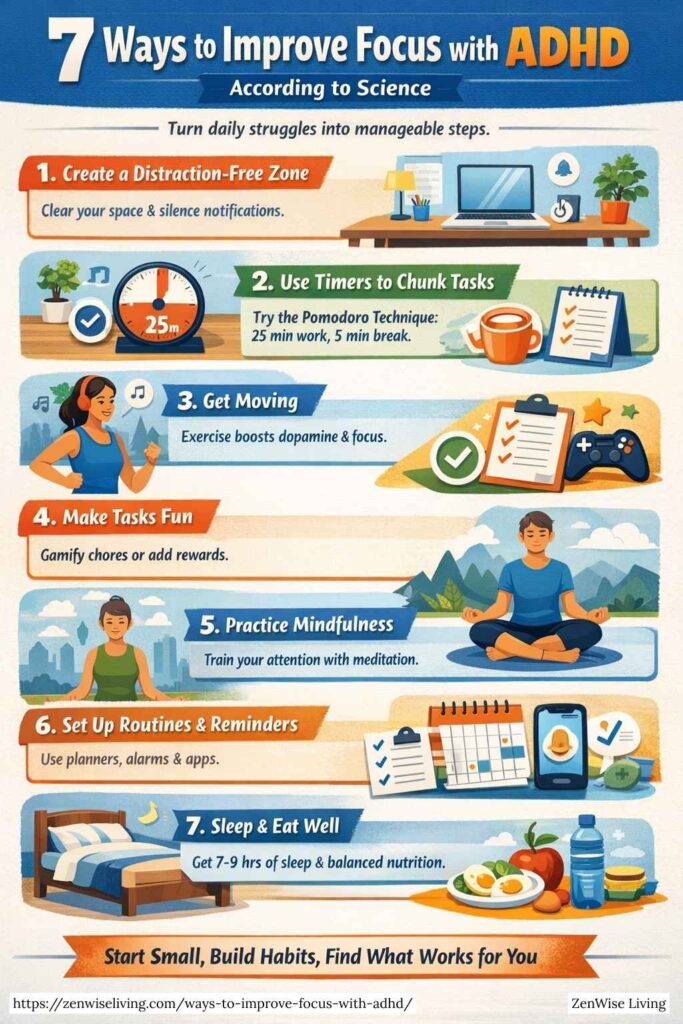
These seven ways to improve focus with ADHD are more than just tips. They are a toolkit for designing a life that works with your brain. The key is not to try them all at once because that is a recipe for feeling overwhelmed.
Start with just one. Pick the method that felt most doable. Maybe it is using a timer tomorrow, or doing a 5-minute desk reset. Try it for a week and see what difference it makes. This is not about perfection. It is about practice and discovering what works for you.
Your ability to focus is not broken. It just needs the right support, the right strategies, and a little bit of self-compassion. You’ve got this.
Common Questions About Ways to Improve Focus with ADHD
You can start by breaking big, overwhelming tasks into tiny, manageable steps to make them feel less daunting. Tools like timers or gamifying a chore can help you push past the initial resistance to get started. It also helps to get things out of your head and onto paper with a quick “thought dump,” as trying to remember everything can clutter the mental space you need for focus.
The 20-minute rule helps you trick your brain into starting a dreaded task. You commit to working on it for just 20 minutes with a timer, which makes the job feel less overwhelming and often gives you the momentum to continue. This method works because it directly addresses the common ADHD challenges of initiation and time perception, turning a small start into a meaningful win.
You can manage ADHD by building supportive habits for your mind and body, including therapy to develop new coping skills and regular exercise to help regulate attention. Implementing organization strategies and mindfulness practices also creates external structure and trains your focus. It is helpful to be mindful of habits that can intensify symptoms, like inconsistent sleep or a diet high in processed foods.
The 5-Second Rule helps you act on a good intention before your brain talks you out of it. When you think of a task you should do, like getting up to start work, you immediately count down “5-4-3-2-1” and then move. This short countdown bridges the gap between thinking and doing, helping you build momentum.
Read More:
7 Natural Stress Relief Methods That Actually Work
How Taming Daily Stress is Your Secret Weapon for a Longer, Healthier Life
